Content Creation Companies: How to Pick the Right One

A good content operation runs on several distinct roles. Most growing businesses can't afford to fill all of them separately.
Here's what a full content company typically covers in-house so you don't have to.
- Content strategist. This person decides what to write and why. They map topic clusters, spot content gaps, and pick which keyword opportunities are actually winnable.
- SEO specialist. They handle on-page SEO, internal linking, and indexing so pages have a shot at ranking. They also read your Google Search Console data to see what's working.
- Writer. The one who turns a brief into a draft that matches your brand voice.
- Editor. They catch weak arguments, fix the flow, and make sure facts hold up before anything ships.
- Publisher or production coordinator. They format the page, add images, and get it live on your CMS.
Outsourcing collapses those five roles into one invoice. You brief once, and the company sorts out who does what.
That's the real draw for a lean team. Hiring even two of these people as employees means salaries, management, and the risk of a gap when someone quits.
The models differ in how many of these roles they actually replace. A freelance writer usually covers the writing, and little else. You're still the strategist and editor.
A freelance network might add light editing, but strategy often stays on your plate. You decide the topics, they fill them.
A full-service agency aims to replace all five. You approve a plan, then step back.
An automated SEO system replaces the roles differently. It handles strategy, SEO, drafting, and internal linking as one connected workflow, then leaves the final call to you.
Knowing which roles you're trying to offload makes the next question easier. If you only need a writer, a whole agency is overkill. If you have no strategist and no SEO know-how, a single freelancer leaves you doing the hardest part yourself.
What Does Hiring a Content Company Cost?
Pricing splits into three common structures, and the one you get depends on the model you pick. Each answers a different question about how much work moves off your plate.
The first is per-piece pricing. You pay a set rate for each blog post, landing page, or product description.
This is how most freelance arrangements and some smaller agencies work. It feels clean because you know the cost before you commit.
The catch is that quality and length swing the rate a lot. A short web page and a deeply researched 2,000-word guide are not the same job, so they are not the same price.
The second structure is a monthly retainer. You pay a flat fee for an agreed volume of content each month, plus the strategy and editing around it.
Full-service agencies usually sell this way. The retainer buys you a team, not just a stack of articles.
Retainers reward consistency. If you need a steady flow of posts month after month, the per-piece cost often drops. That compares favorably to buying one at a time.
The third is a subscription, which is how software and automated SEO systems charge. You pay a recurring fee for the tool, and volume is usually capped by your plan tier rather than billed per article.
The pricing math changes here. You are paying for a system that runs the workflow, not a person completing each task by hand.
What Actually Moves the Price
Volume is the biggest lever. Ten posts a month costs more than two, and most providers scale their fee with output.
Scope is the second lever. A piece that includes keyword research, SEO setup, and internal linking costs more than raw copy you still have to optimize yourself.
Revisions and ownership matter too. Some providers include edits in the price. Others bill extra, or charge for the strategy that tells the writers what to make.
Here is a rough way to compare the three without guessing at figures.
| Model | How You Pay | Best When |
|---|---|---|
| Freelancer | Per piece | Low, irregular volume |
| Agency | Monthly retainer | Steady volume plus strategy |
| Automated SEO system | Subscription | High volume, you keep control |
One number worth running before you sign anything is your break-even ROI. Estimate what one ranking post is worth to you in leads or sales, then compare that to the monthly cost.
Say a single converting page brings in enough revenue to cover a month of a retainer. At that point the spend pays for itself, and anything above it is profit.
Per-piece rates look cheapest on paper. They often aren't once you add the strategy and editing a good agency or system includes in the base price.
Four Other Ways to Get Content Made
Hiring a company is one route. Three others compete for the same budget, and each trades control for cost in a different way.
Think of them as a spectrum. On one end, people do everything by hand. On the other, software runs most of the work and you review the output.
An in-house hire puts a writer or content marketer on your payroll. You get someone who learns your product deeply and sits in your meetings.
The catch is capacity. One person writes a limited number of good pieces per month. They still need a strategist and editor around them to perform well.
Freelancers you manage directly give you flexible volume without a salary. You find writers, assign briefs, and handle the editing and SEO yourself.
This keeps per-piece costs low and control high. It also makes you the project manager, which is real work when you are juggling several writers at once.
Spreadsheet DIY means your team runs the whole thing manually. You track keywords in a sheet, write briefs, draft in a doc, and publish by hand.
It costs nothing but time, and the time adds up fast. Topic research, internal linking, and tracking what ranks all land on someone who probably has another job.
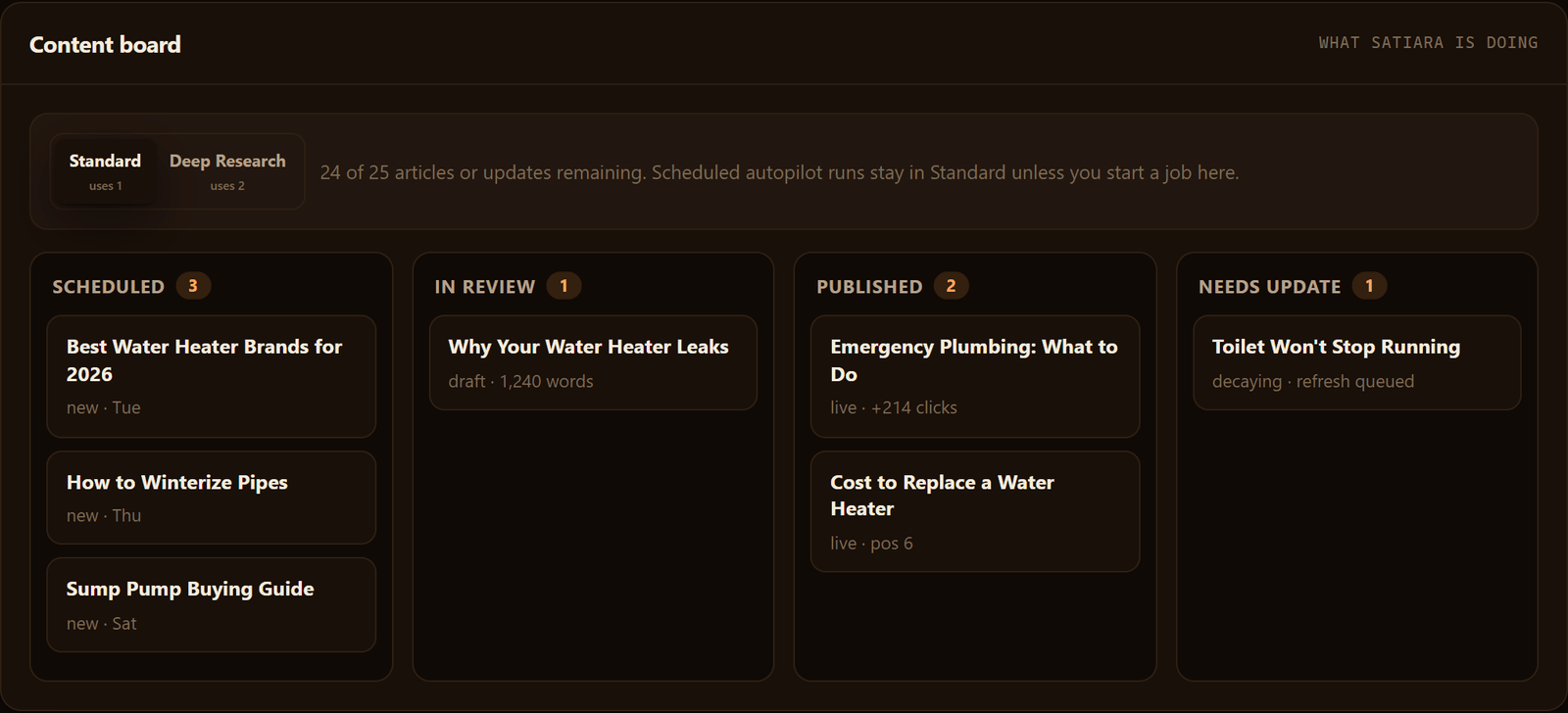
Software that runs the SEO workflow sits between DIY and a full agency. Instead of only generating text, an SEO operating system studies your site and reads your Google Search Console data. It finds winnable opportunities before anything gets written.
That matters because writing is one step in a longer chain. A tool like Satiara handles the strategy, the drafting, the internal linking, and the on-page SEO. Then it lets you choose review mode or auto-publish.
The honest question with any software is control. You want to know it never makes destructive structural changes to your site without your sign-off. You also want content that can match your brand voice.
Here is how the four options line up on the things you actually weigh.
| Option | Best when | You handle |
|---|---|---|
| In-house hire | You need deep product knowledge and steady low volume | Salary, management, filling skill gaps |
| Managed freelancers | You want flexible volume and will edit yourself | Sourcing, briefs, editing, SEO |
| Spreadsheet DIY | Budget is near zero and you have spare time | Everything, by hand |
| SEO software | You want the full workflow run with you in control | Goals, voice, review decisions |
None of these is automatically right. The fit depends on your volume, your budget, and how much of the process you want to own versus hand off.
How to Choose Between an Agency, Freelancers, and an SEO System
Three real models exist for getting content made without an in-house team. Each one wins in a different situation.
Match the model to your volume, your budget, and how much of the process you want to control.
The Three Models at a Glance
A full-service agency handles strategy, writing, and editing as one package. You brief them, they deliver finished pages.
This suits you when you want a partner to own the work and you have the budget for retainer pricing.
A freelance platform gives you a pool of writers you manage directly. You pick people, assign briefs, and review what comes back.
Freelancers fit when you want lower per-piece cost and you have someone in-house to run the pipeline.
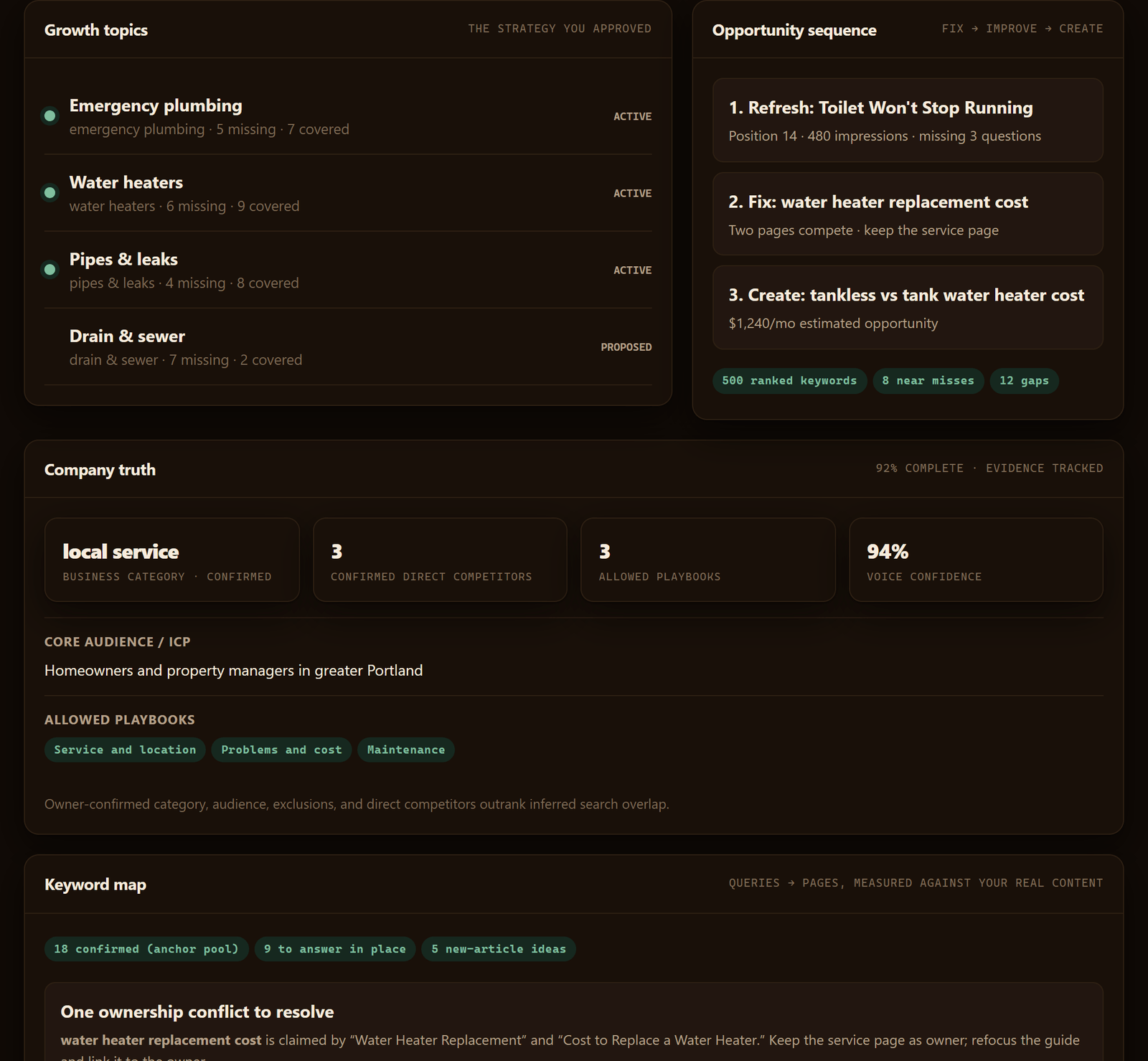
An automated SEO content system is software that studies your site, reads your Google Search Console data, and finds winnable opportunities. It builds a plan, writes pages, and handles on-page SEO as a connected workflow.
A system fits when you want steady volume at a predictable cost without hiring or managing people.
When an SEO System Beats Hiring People
Hiring makes sense when content is a small part of a bigger creative relationship. A system makes sense when the goal is search traffic and you want the whole workflow to run.
A directory of agencies assumes you already want to hire. It skips the question of whether software can do the strategy, writing, and internal linking for you.
The real difference is scope. A writer produces a page. A system ties each page to a topic cluster, links related pages, and watches whether they rank.
That matters because content without search data is a guess. Ranking depends on finding keywords you can actually win, not just publishing more words.
Do You Lose Control if You Automate?
This is the fear that stops most buyers. You should not have to trade control for speed.
A well-built system keeps you in charge of goals, brand voice, and clusters. You decide the strategy, and the software executes it.
Look for a review-first mode, where you approve each page before it goes live. Auto-publish is a choice, not a default forced on you.
Structural changes carry more risk than new pages. Redirects and page consolidations can hurt rankings if applied blindly.
A safe system never silently makes destructive changes. It flags them and waits for your approval. Satiara, for example, keeps those choices under your control.
A Decision Framework by Volume, Budget, and Control
Pick by your tightest constraint. If budget is the limit, start with freelancers or a system over an agency retainer.
If volume is the limit, a system scales without the hiring delay. If brand control is the limit, choose an agency you trust or a system with review mode.
High volume plus tight budget usually points to software. One-off campaigns with heavy creative needs usually point to an agency.
Questions to Ask Any Provider Before You Sign
These apply whether you are hiring an agency, booking freelancers, or buying software.
- How do you decide what to write? Do you use real search data or just keyword guesses?
- Will the content match my brand voice, and can I see a sample first?
- Who owns strategy, me or you?
- Can I review each piece before it publishes, or does it go live automatically?
- How do you handle internal linking and on-page SEO, not just the words?
- What happens to structural changes like redirects? Are they ever applied without my sign-off?
- How do you measure results, and how long until I see ranking movement?
Where These Providers Disappoint Buyers
Agencies can drift from your voice when work passes through junior writers. Ask who actually writes.
Freelancers vary piece to piece, and managing them becomes a job of its own. The hidden cost is your time.
Software disappoints when it is a writing tool wearing a bigger name. If it cannot read your Search Console data or link pages into clusters, it is just a text generator.
When a Content Company Is Not the Right Choice
Skip the agency route if your main need is ongoing SEO rather than one-time campaigns. A retainer for a fixed page count rarely adapts to what search data shows.
Skip freelancers if nobody in-house can run the pipeline. Unmanaged freelancers produce scattered content with no strategy behind it.
Your First Steps to a Steady Pipeline
Start by connecting your site to Google Search Console so any provider can see real data. That is the base for finding winnable opportunities.
Then run a short trial before committing. Judge the first few pages on voice, accuracy, and whether they target keywords you can realistically rank for.
Choose review mode at the start. Once you trust the output, you can let more of the workflow run on its own.
Matching the Model to Your Situation
Pick by your tightest constraint. If brand voice matters most, choose an agency you trust or a system with a review-first mode.
Whatever you choose, connect your site to Google Search Console and run a short trial before you commit. Tools like Satiara let you keep review mode on until the output earns your trust.
Frequently asked questions
What is the usual contract length for a content company?
Contract length varies by model. Agencies often ask for a multi-month retainer commitment, while freelance work can be booked per piece with no ongoing term. Subscriptions for automated systems tend to bill monthly, so you can scale up or stop without a long lock-in.
Who owns the content a provider creates for me?
Ownership depends on the agreement, so confirm it before you sign. Ask whether finished pages and their strategy transfer fully to you. Some hand over all rights, while others retain the plan or templates, so clarify this up front.
Are there content creation companies based in the USA?
Yes, many content creation companies operate in the USA. These include full-service agencies and freelance marketplaces like Upwork, Contently, and ClearVoice. Location matters less than the model you choose, since an automated SEO system serves you globally as software.
Are content creation companies hiring, or should I hire one?
If you are searching to hire a content creation company rather than join one. Start by deciding which roles you want to offload. A single writer covers drafting only, while an agency aims to replace strategist, SEO specialist, writer, editor, and publisher.
An automated system handles strategy, drafting, and on-page work, leaving the final call to you.
How long before outsourced content starts ranking?
Ranking usually takes weeks to months, since Google needs to index pages and judge them against existing results. Run a short trial first by connecting your site to Google Search Console. Then judge early pages on voice, accuracy, and keywords you can realistically rank for before expecting traffic.
About Satiara
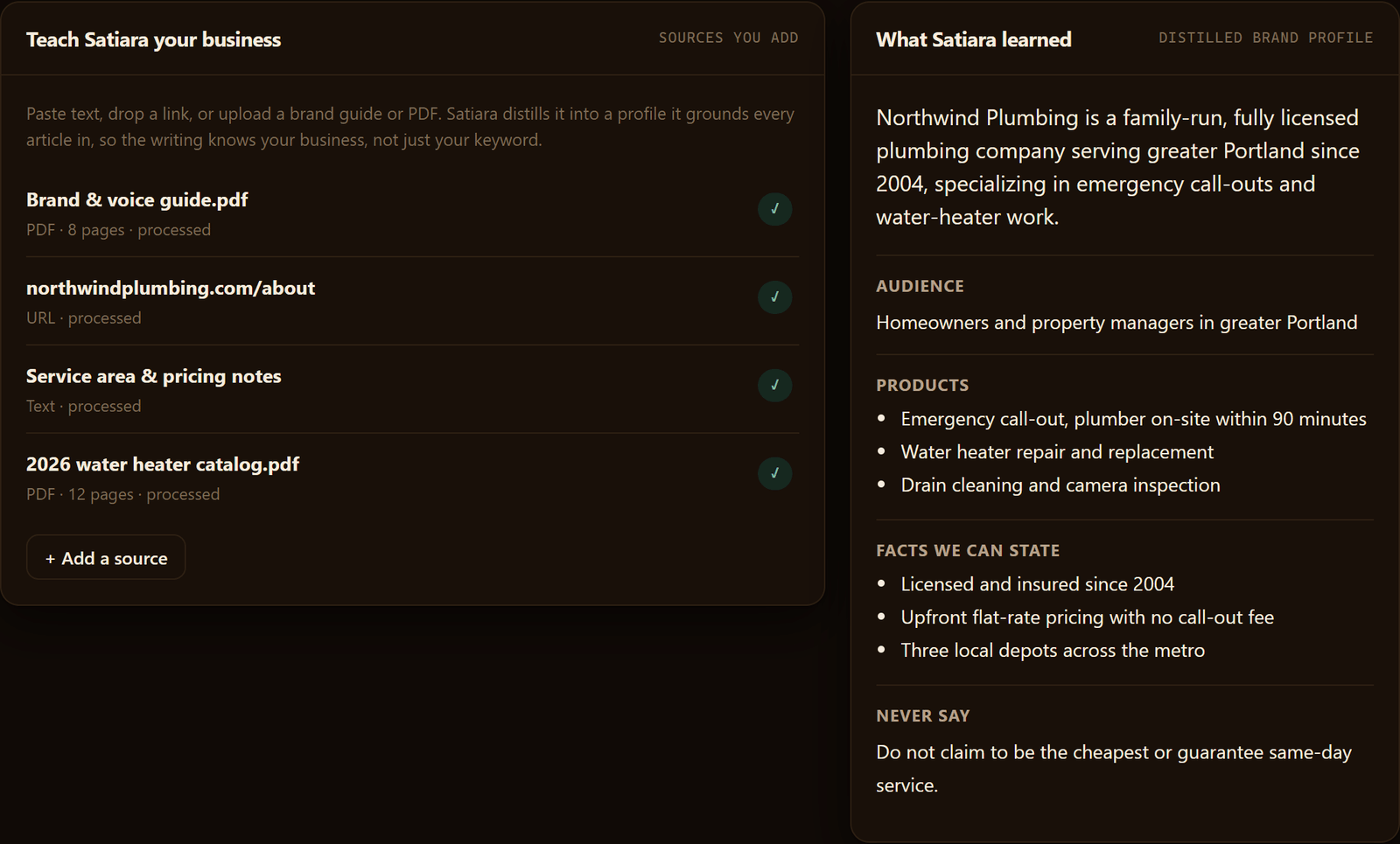
Satiara is an AI-driven SEO automation for a startup or SaaS founder. This article was written by the Satiara team. More about Satiara.