How to Rank in ChatGPT Answers
Key takeaways
- Let OpenAI's OAI-SearchBot crawl your site, since blocking it drops you out of ChatGPT's live search answers and citations.
- Structure key pages answer-first, with question-based headings and a plain answer in the first line. This way, a model can lift a clean citation.
- Build topic clusters instead of one perfect page, because ChatGPT splits questions into many sub-queries and rewards brands that appear across them.
- Earn mentions on review sites, roundups, and community threads, which the model trusts far more than your own website copy.
- Fix normal Google indexing and rankings first, since live browsing leans on the same signals search engines use.
When someone says ChatGPT recommended a tool, there is no page of blue links behind it. There is one answer, and your brand is either in it or it isn't.
That changes the work. You are not chasing an exact keyword a person typed. You are giving the model something clean to read and good reasons to name you.
This guide covers how ChatGPT picks brands, why answers vary, and how live browsing differs from trained memory. It also covers the on-page and off-site moves that raise your odds.
What "Ranking" in ChatGPT Actually Means
When someone says ChatGPT recommended you, they don't mean you sat at position one on a results page. There is no page. There is a single answer, and your brand either appears inside it or it doesn't.
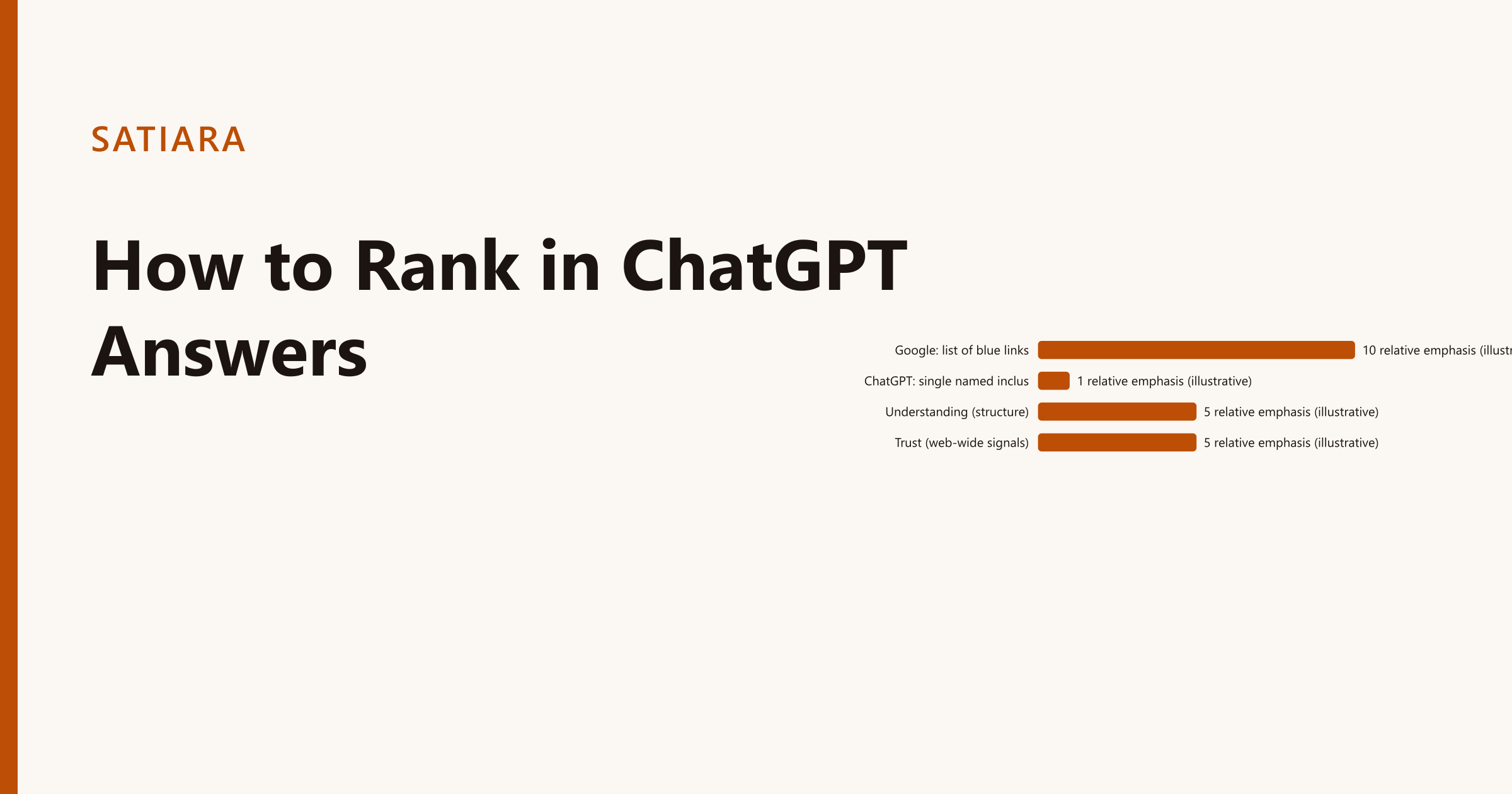
Google ranking vs ChatGPT mention: how inclusion works
Illustrative values, drawn to compare shapes, not to report a measurement.
That is the first shift to accept. A Google ranking is a list of blue links. A ChatGPT mention is a named inclusion in a sentence the model writes on the spot.
So "ranking" here really means being retrieved and cited. The model pulls facts it trusts, then names the sources or brands behind them while it answers.
Google matches keywords and links to a query, then orders them. ChatGPT works by meaning instead, converting your content into embeddings (types of data expressed in numerical form). These let it spot meaning even when the wording isn't exact, a method GeeksforGeeks calls semantic search.
That difference matters for what you write. You are no longer chasing an exact phrase a person typed. You are trying to be the clearest, most trustworthy source on a topic the model can recognize.
Two questions decide whether you get named. Does the model understand what your page says? And does it trust that your page is accurate?
Structure answers the first one. Atomic AGI points to well-structured content that is easy to parse and rich in verified information as ideal for these systems. Messy pages get skipped even when the facts are good.
Trust answers the second. The model leans on signals from across the web, not just your own site, to judge whether naming you is safe. That is why a competitor with strong reviews and mentions shows up while you don't.
Keep this frame as you read the rest. You are not gaming a ranking. You are giving the model something clean to read and good reasons to believe you.
How ChatGPT Picks Which Brands to Name
ChatGPT does not keep a ranked list of companies. It generates an answer word by word, predicting what fits best based on patterns in its training data. When browsing is on, it also uses what it just read on the web.
So a brand gets named for one of two reasons. Either it appeared often enough in the model's training data to feel like a natural answer. Or the live search step surfaced a page that mentions it.
Both come down to the same question. Does the model have a clear, repeated signal that your brand belongs in this answer?
Think of it less like a search index and more like a well-read colleague. They recommend the names they have seen praised in many places, described consistently, and tied clearly to a specific problem.
That shapes what actually moves the needle. Frequency of mention matters. So does the consistency of how you are described across the web.
A brand described five different ways in five places gives the model a fuzzy picture. A brand described the same way everywhere gives it a sharp one.
Context matters as much as frequency. The model learns which brands go with which problems by seeing them mentioned together, again and again.
If your name shows up next to a specific use case in reviews, roundups, and forum threads, ChatGPT connects the two. Ask about that problem later, and your name is a likely completion.
Here is what feeds that pattern, roughly in order of weight:
- Third-party mentions. Reviews, comparison posts, and industry lists carry more weight than your own site, because they read as independent.
- Consistency of description. The same positioning across many sources teaches the model what you are for.
- Problem-to-brand links. Being named alongside a clear use case, not just listed generically.
- Your own pages. They confirm and clarify, but rarely start the conversation on their own.
Notice what is missing from that list. There is no meta tag, no keyword you can stuff, no single page you optimize to win.
The model is reading a reputation, not a ranking. Your job is to make that reputation legible and repeated, so the pattern points at you when the right question comes up.
One caveat worth holding onto. The training-data side is slow and mostly out of your hands in the short term. It reflects the web as it was captured months ago.
The browsing side is faster and more within reach, which is why it deserves its own section next.
Why the Same Question Gives Different Brands
Ask ChatGPT the same question twice and you may get two different sets of brands. This throws people off, so it helps to know why it happens.
The model does not read from a fixed list. It generates each answer from probabilities, and small changes shift what comes out. Your account, your chat history, and the exact wording all nudge the result.
Randomness is built in on purpose. It keeps answers from sounding like a canned script. The trade-off is that a brand named on Monday might vanish on Tuesday.
Live browsing adds another layer of drift. When ChatGPT pulls fresh web results, the pages it grabs can change hour to hour, so the brands it cites change too.
What Steadies Your Odds Over Time
You cannot control any single answer. You can raise the baseline chance that your brand shows up across many answers.
Two things move that baseline. How often your brand appears in the training data, and how strong your presence is on the sources ChatGPT trusts to browse.
Off-site authority is the bigger lever here. When independent sites mention you, review you, or include you in a roundup, the model sees a pattern. Your brand gets tied to your category again and again.
Think of it as weight, not a switch. A single mention rarely tips an answer. A steady pattern of mentions across credible sites builds the association that surfaces later.
- Earned mentions: press, podcasts, and articles that name you in context.
- Honest reviews: third-party review sites where real customers describe what you do.
- Best-of lists: roundups in your category that include you next to known names.
The Honest Caveat About Best-Of Lists
Some founders try to shortcut this by paying for placement. Others spin up their own "top 10" posts that conveniently rank themselves first. It can work for a while.
The problem is durability. AI systems and search engines both keep getting better at spotting low-quality, self-serving pages, often called AI slop.
When those sources lose trust, the mentions they carry lose weight too. You end up rebuilding on a foundation that keeps washing out.
Real citations from sources people actually rely on hold up far better. That is slower, but it survives the next model update instead of getting scrubbed by it.
So treat volatility as normal and manipulation as a dead end. Aim for genuine coverage on trusted sites, and let the odds compound in your favor over months, not days.
How Live Browsing Differs From ChatGPT's Trained Memory
ChatGPT has two ways to know about you. One is baked in. The other happens in real time.
Its trained knowledge comes from a snapshot of the web taken during model training. That data is frozen at a cutoff date. If you launched last month, the base model has never heard of you.
Live browsing works differently. When ChatGPT searches the web to answer a question, it fetches current pages and reads them. It pulls quotes or facts into its reply.
These two modes reward very different things. The trained model favors brands that were widely written about before the cutoff. Live search favors pages that rank right now and answer the exact question asked.
That split matters for you. You cannot edit a frozen snapshot. You can influence what live search finds today.
When Does ChatGPT Actually Browse?
It does not search on every question. Simple factual asks get answered from memory. Browsing usually kicks in for recent events, specific recommendations, or anything the model senses it might be stale on.
Questions like "best invoicing tools for freelancers" often trigger a live search. The model wants current options, not last year's list.
So the recommendation questions you care about are exactly the ones most likely to pull live pages. That is good news if your content is findable.
What Browsing Reads First
When ChatGPT browses, it leans on a regular search index to decide which pages to open. It does not crawl the whole web live. It queries, gets a shortlist, and reads the top results.
That means classic ranking still feeds the pipeline. If your page shows up for the underlying query, it has a shot at being read and quoted.
The model then skims for a clean, direct answer it can lift. Pages that bury the point make poor sources. Pages that state the answer plainly get pulled in.
What This Means For Where You Spend Time
Two moves compound here. Build pages that rank for the questions people actually type. Then write those pages so the answer is easy to extract.
You do not need to chase the frozen model. You need to be the current, rankable, quotable source when browsing fires.
This is where a steady SEO workflow pays off. Reading your real Google Search Console data shows which queries you already appear for. You then know which pages are worth sharpening for live retrieval, and later sections cover on-page structure that makes extraction clean.
How Much of Your SEO Work Still Counts?
Most of it. ChatGPT does not build a separate internet to pull from.
When it browses live or leans on its training, it draws from pages that already exist, get indexed, and earn trust. The plumbing you built for Google feeds the same well.
Indexing is still the price of entry. If Googlebot can crawl and store your page, ChatGPT's web search can find it too. A page blocked from crawlers is invisible to both.
Authority still carries weight. Pages that other sites reference tend to get retrieved and cited more often. The model treats those references as signals of trust.
So the foundation holds. Where things split is what you optimize for.
Traditional SEO aims for a click. You want the blue link, the ranking, the visit.
Answer optimization aims for a mention. You want the model to lift your fact, name your brand, and quote your page inside a reply the user never leaves.
That shift changes a few priorities:
| Still matters as much | Matters more now | Matters less |
|---|---|---|
| Indexing and crawlability | Clear, extractable answers near the top of a page | Exact-match keyword density |
| Topical depth and clusters | Third-party mentions the model already trusts | Click-through headline tricks |
| Site structure and internal linking | Plain-language phrasing that matches spoken questions | Chasing raw keyword volume alone |
Notice that the left column is ordinary on-page SEO. Nothing there is wasted.
The gap between the taxonomies (SEO, AEO, GEO) is a topic on its own, and we cover it separately. For your purposes here, treat them as one workflow with a wider goal.
If you want a lever to pull first, start where you already have traction. Pages that rank in the top handful of Google results are the ones live retrieval reaches for.
Sharpen those before you build new ones. A tool like Satiara reads your Google Search Console data to show which pages already earn impressions. That way you refresh the winnable ones instead of guessing.
The short version: keep your SEO habits, then add extraction and mentions on top.
Why Third-Party Mentions Beat Your Own Website Copy
Your website says you are the best. Every website says that. ChatGPT has read millions of pages that all make the same claim about themselves.
So it learned to discount first-party copy. When a brand describes itself, that carries almost no evidentiary weight, because the source has an obvious stake in the answer.
A review site, a comparison roundup, or a Reddit thread is different. Those sources have no reason to flatter you. When they name your product, the model treats that as closer to fact than opinion.
Think of it the way a hiring manager treats references. Your resume is the pitch. The reference call is the check.
What Third-Party Signals Actually Do
Three things happen when many independent sources mention your brand for the same use case.
- Corroboration. The same claim from unrelated sources reads as consensus, not marketing.
- Association. Repeated pairing of your brand with a specific need teaches the model when to surface you. An example is "SEO tool for founders with no in-house team."
- Coverage. More independent pages mean more chances that a retrieval step lands on one that names you.
Your own page can still be excellent and worth writing. It just cannot vouch for itself.
Why Listicles Punch Above Their Weight
A "best tools for X" article does the model's grouping work in advance. It places your brand next to competitors under a clear category label.
That structure is easy to extract. When someone asks for options, the model already has a tidy list to draw from, with you inside it.
One glowing testimonial on your homepage does none of that. It sits alone, unverified, on a page the model already treats as biased.
What This Means for Where You Spend Effort
Keep polishing your site, but stop expecting it to carry the trust load. The trust comes from outside.
Aim to get named in places you do not control: review directories. Comparison posts, community answers, and podcasts or newsletters in your niche. Each independent mention is a small vote the model can count.
The later sections cover how to earn those mentions. They also show how to shape your own pages so they get quoted once a source points to you.
How to Structure a Page So ChatGPT Can Extract a Clean Answer
ChatGPT quotes the sentence that answers the question, not the paragraph around it. Your job is to make that sentence easy to find and safe to lift out of context.
The pattern that works is answer-first. State the plain answer in the first line under a heading, then support it. Do not warm up, and do not bury the claim in the third sentence.
The Answer-First Page Template
Write your headings as the actual questions a person would type or ask. Then answer each one in the opening line below it.
A page about, say, invoicing software might look like this:
- H2: What is [Product] and who is it for? One or two sentences that name the product, the category, and the exact user.
- H2: How does [Product] handle recurring invoices? The answer first, then the how.
- H3: Does it support multiple currencies? Yes or no in the first four words, then detail.
- H2: How much does [Product] cost? The pricing shape stated plainly, no scroll hunting.
Each heading is a question. Each answer stands on its own. A model can pull any one block and still be right about you.
Why the Order Matters
ChatGPT often works with a snippet, not the whole page. If your answer lives at the end of a paragraph, the snippet may cut it off. Front-loading protects the fact from getting trimmed away.
Keep each answer self-contained. Avoid "as mentioned above" or "see below," because a lifted block loses its neighbors.
Before and After: A Promotional Paragraph
Here is a typical marketing paragraph, the kind that reads fine to a human but gives a model nothing to grab.
Before: "We're passionate about helping growing teams do their best work. Our platform was built from the ground up with your success in mind. And thousands of happy customers agree that we make life easier."
Nothing there answers a question. There is no category, no feature, no user, no fact to quote.
After: "[Product] is scheduling software for dental clinics. It syncs appointments across locations and sends automatic reminders by text. Clinics with two to ten chairs use it most."
The rewrite names the category, the buyer, and two concrete features. A model can now answer "what scheduling tool do dental clinics use" and cite you cleanly.
Do this across your key pages, and your SEO workflow starts feeding both Google and ChatGPT from the same structure. If reviewing every page by hand is too much, an SEO operating system like Satiara can hold this pattern across a site. It runs in review-first mode so nothing publishes without your say.
How to Write for the Questions People Actually Ask
People type full questions into ChatGPT, not keyword fragments. So your content has to answer the way someone speaks.
Write pages that respond to a real question in the first two sentences. Then support the answer with detail underneath.
The trick is understanding how ChatGPT finds and ranks your content in the first place. Once you see the pipeline, the writing strategy gets obvious.
How ChatGPT Picks and Cites Content, Step by Step
A single question rarely stays a single question. ChatGPT often splits it into several related searches, a step called fan-out.
Ask "how do I rank in ChatGPT answers" and it may quietly search for retrieval, citations, freshness, and structured content. Each sub-query pulls its own set of pages.
Those results get merged. The most common method is Reciprocal Rank Fusion, or RRF, which rewards pages that show up across many sub-queries.
After fusion, a reranker reads the top candidates and scores them for how well they actually answer the question. Fresh pages often get a bump here too.
There's a safety pass as well. According to the OWASP Foundation, content is scanned at this stage for things that might look like prompt injection. So keep your pages clean and honest.
What survives all of that gets assembled into the answer you read. Getting cited means clearing every gate, not just one.
Why Breadth Beats a Single Number-One Ranking
Here is the part most pages miss. RRF adds up your position across many sub-queries, so mediocre placement in several searches can outscore one top spot.
The math is simple. RRF gives each result a score of roughly 1 divided by (60 plus its rank), then sums those scores.
| Page | Ranks across 4 sub-queries | Approx. RRF score |
|---|---|---|
| Page A | #1, not found, not found, not found | 0.0164 |
| Page B | #5, #6, #4, #7 | 0.0602 |
Page A wins one search outright. Page B never ranks first, yet it wins the fusion by a wide margin.
That is why depth and breadth beat a single trophy keyword. You want to appear in many of the sub-queries a fan-out generates.
Why Topic Clusters Give You More Entry Points
A topic cluster is a group of connected pages covering one subject from many angles. Each page becomes a separate doorway into the fan-out.
One deep page might match two sub-queries. A cluster of eight linked pages can match twenty.
Build a pillar page on your core topic. Then surround it with pages answering the smaller questions people actually ask, and link them together.
This is the workflow angle most guides skip. They optimize one article when the pipeline rewards a well-linked set.
Why Freshness Changes Whether You Get Surfaced
The reranker and the browsing side both favor recent content. A page last touched two years ago looks stale next to one updated this quarter.
Refreshing content also signals that your answer still holds. Update figures, prune dead advice, and add new questions as they emerge.
You don't need to rewrite everything monthly. Set a review cadence, and let a system like Satiara flag which pages have gone quiet. Then you refresh the ones that matter.
How to Earn Third-Party Mentions ChatGPT Trusts
ChatGPT names brands it has seen described by other people, not just by you. Your own site says you're great. A review roundup, a Reddit thread, or an industry directory saying it carries more weight.
You don't buy those mentions. You earn them by being the kind of company people write about.
Where the Trusted Mentions Actually Live
Think about who already writes about tools in your category. Comparison sites, niche blogs, podcast show notes, and community threads all get read during training and during live search.
Your job is to make it easy for those people to mention you accurately. Send a clear one-paragraph description of what you do and who you serve.
- Comparison and "best X" roundups in your category, where you may only rank a mention, not a full recommendation.
- Community threads on Reddit, Hacker News, or Slack groups where buyers ask for recommendations.
- Guest contributions and podcasts that leave a searchable transcript with your name in it.
- Directories and integration pages on partner sites that describe your product in plain terms.
A mention is your name appearing. A citation is your page linked as the source. Decision-level queries ("best tool for X") reward mentions across many sites, while informational queries reward a clean, quotable page of your own.
How to Check if ChatGPT Already Names You
Ask ChatGPT the questions your buyers ask. "What are good SEO tools for a SaaS founder with no specialist?" See who gets named.
Run the same prompt a few times and on different days. Answers shift, so track a few core questions on a schedule instead of trusting one result.
Keep a simple spreadsheet. Log the question, the date, and which brands appeared. Over weeks you'll see whether your name starts showing up.
Let ChatGPT's Crawlers In
OpenAI uses more than one crawler, and they do different jobs. Blocking the wrong one can quietly erase you from answers.
| User-agent | What it does | Block it and... |
|---|---|---|
| GPTBot | Gathers pages that may train future models | You may lose future model knowledge of your brand |
| OAI-SearchBot | Indexes pages for ChatGPT's live search feature | You drop out of search-based answers and citations |
| ChatGPT-User | Fetches a page when a user's live request needs it | ChatGPT can't open your page mid-conversation |
Most robots.txt guides treat these as one thing. They aren't. Blocking training can also cut off the citation path, so decide each one on purpose.
To allow all three, your robots.txt can read like this:
- User-agent: GPTBot / Allow: /
- User-agent: OAI-SearchBot / Allow: /
- User-agent: ChatGPT-User / Allow: /
If you want to appear in ChatGPT search but stay out of training, allow OAI-SearchBot and ChatGPT-User while disallowing GPTBot. Accept the tradeoff either way.
Track ChatGPT Referrals in GA4
Some ChatGPT clicks show up in your analytics as referral traffic. You can filter for them.
- Open GA4 and go to Reports, then Acquisition, then Traffic acquisition.
- Set the primary dimension to Session source / medium.
- Add a filter on that dimension using a match type of "matches regex".
- Enter the pattern chatgpt|openai.
- Save it as a comparison or a custom exploration so you can reopen it weekly.
This only catches sessions where someone clicked through. Plenty of ChatGPT mentions never generate a click, so treat GA4 as a floor, not the full picture.
What You Cannot Control
You can't control which pages a model trained on, when it last updated, or the exact wording of any answer. Feedback loops are slow, sometimes months between action and mention.
There's also no clean attribution. A lead who says "ChatGPT sent me" rarely shows a referral link. Watch for that phrase in intake forms and sales calls, since it's often your best signal.
When This Should Not Be Your First Move
If your site isn't indexed or your core pages don't rank in normal search, fix that first. ChatGPT's live search leans on the same signals Google uses.
Chasing ChatGPT visibility before you have a solid page structure and real Google Search Console demand is backwards. Get found in search, and the AI answers tend to follow.
A Realistic First 90 Days
Here's a plan a solo owner can run without an agency.
- Days 1 to 15: Check your robots.txt, allow the OpenAI crawlers you want, and confirm your key pages are indexed.
- Days 15 to 30: Rewrite your top three buyer pages with answer-first paragraphs, question-based headings, and a comparison table or list.
- Days 30 to 60: Log ten buyer questions in ChatGPT, note who gets named, and set up the GA4 referral filter.
- Days 60 to 90: Send accurate descriptions to two or three roundup writers. Join the community threads where buyers ask, and refresh any page that has gone quiet.
Set a monthly review instead of a daily obsession. A system that reads your Search Console data can flag which pages are slipping. You spend your hours on the ones that move revenue while keeping final say over voice and structure.
Where to Start This Week
You do not need to rebuild everything. Confirm your pages are indexed, let the right OpenAI crawlers in, and pick your top buyer pages to rewrite answer-first.
From there, the work compounds. Depth across a topic cluster, steady refreshes. And honest mentions on sites people actually trust all point the same pattern at your brand.
Treat volatility as normal and skip the shortcuts. Genuine coverage survives the next model update. Manufactured lists do not.
Frequently asked questions
How long does it take to show up in ChatGPT answers?
Expect months, not days. The training side reflects a web snapshot from before the cutoff. Even the live browsing side needs repeated mentions before the pattern points at you.
Do I need to submit my site to OpenAI to be included?
No. There is no submission form. ChatGPT's live search finds pages through a regular search index, so being crawlable and ranking normally is what gets you read.
Will blocking GPTBot hurt my ChatGPT visibility?
It can. GPTBot gathers pages for future model training, so blocking it may keep the base model from learning your brand. If you only want live search, allow OAI-SearchBot and ChatGPT-User instead.
Can I pay to be recommended by ChatGPT?
No, and paid placement or self-ranking lists tend to lose weight over time as AI systems get better at spotting self-serving pages. Earned coverage on trusted sources holds up better.
How do I know if a lead came from ChatGPT?
Attribution is loose. Some clicks appear as referral traffic you can filter in GA4, but many mentions never produce a click. Watch for people who say ChatGPT sent them in forms and calls.
About Satiara
Satiara is an AI-driven SEO automation / SEO operating system for a startup or SaaS founder. This article was written by the Satiara team as part of our ongoing coverage of how to rank in chatgpt answers. More about Satiara.